
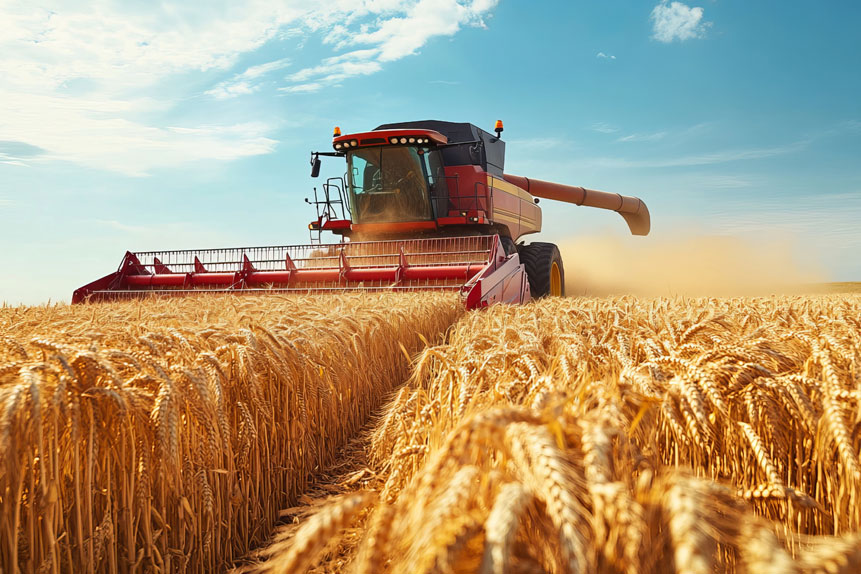
From Tradition to Transformation: How Farm Operations Are Evolving
The modern grain farmer must now balance operational efficiency with long-term sustainability. Agriculture has always demanded resilience, but today’s producers are navigating one of the fastest periods of change the industry has ever experienced. Higher production expectations, tighter margins, and environmental pressures are forcing farms to operate with greater precision than ever before.
If you’re new to this topic, start with our complete guide to modern grain farming, which breaks down the core practices shaping today’s agricultural landscape.
Modern farm operations are increasingly guided by measurable insights rather than instinct alone. Decisions surrounding planting timelines, soil preparation, crop rotation, and storage strategies now rely heavily on analytics that strengthen both efficiency and long-term profitability.
This marks a powerful shift across agriculture — successful farms are no longer reacting to challenges as they arise. Instead, they are planning ahead, forecasting risk, and building operational systems designed for stability.

Why Technology Has Become the Engine of Modern Agriculture
Digital innovation is rapidly redefining what efficient farm management looks like. What was once considered advanced is quickly becoming standard practice for operations focused on long-term competitiveness.
Technology’s Growing Role in Agriculture explores how connected tools help producers monitor field conditions, anticipate production outcomes, and streamline day-to-day workflows from a centralized environment.
Rather than juggling disconnected spreadsheets, software platforms, and manual processes, many farms are transitioning toward integrated systems that provide real-time operational visibility.
What Smart Farm Technology Enables
- More accurate production forecasting
- Reduced waste across inputs
- Stronger operational efficiency
- Faster, data-backed decisions
- Improved financial predictability
Importantly, innovation does not replace agricultural expertise — it amplifies it. When experience is paired with intelligent tools, producers gain greater control over uncertainty.
Farms that lean into modernization are positioning themselves to remain profitable and resilient regardless of market volatility.
Sustainability Has Shifted From Ideal to Imperative
Responsible land management is no longer optional — it has become a defining characteristic of successful agricultural businesses.
Practices such as protecting soil health, optimizing water usage, and minimizing chemical dependency all contribute to stronger long-term output while safeguarding farmland for future generations.
Market expectations are also evolving. Buyers, regulators, and supply chain partners increasingly favor producers who demonstrate environmental accountability.
Forward-thinking operators understand that maximizing a single season should never jeopardize decades of productivity. Sustainability, when executed strategically, becomes a growth driver rather than a constraint.
Inside the Future-Ready Farm
The next generation of farms is defined by connectivity, automation, and proactive planning rather than reactive problem-solving.
Future-Ready Farming: The Modern Farmers App Advantage illustrates how management platforms help coordinate workflows, reduce administrative burden, and deliver clearer operational insight across the enterprise.
When accurate information moves seamlessly across an operation, leadership teams can focus less on damage control and more on performance optimization.
Traits of a Future-Ready Operation
- Centralized operational data
- Predictive planning tools
- Digitized processes
- Transparent performance tracking
- Infrastructure built to scale
Preparedness is quickly becoming agriculture’s strongest competitive advantage.
The Expanding Role of the Modern Grain Farmer
The role of today’s producer extends far beyond fieldwork. Modern agricultural leaders operate at the intersection of strategy, finance, technology, and environmental stewardship.
Many now function simultaneously as:
- Business operators
- Data interpreters
- Equipment decision-makers
- Risk managers
- Supply chain participants
This evolution signals a broader industry transformation — one where insight drives action and preparation outperforms reaction.
Producers who remain committed to learning, adapting, and investing in smarter infrastructure are the ones most likely to thrive as agriculture grows more complex.
Why This Shift Matters Now More Than Ever
Feeding a growing population requires farms that are not only productive but also resilient under pressure.
Operations leading the industry forward are rarely defined by size alone — they are distinguished by strategic clarity, operational discipline, and adaptability.
The future of agriculture will belong to producers who embrace intelligence-driven systems while staying grounded in proven agronomic principles.
Conclusion: Building Farms Designed for the Future
Agricultural progress is not about abandoning tradition — it is about strengthening it with smarter tools and clearer strategy.
Producers who prioritize innovation, operational visibility, and responsible land management are actively shaping the next era of farming rather than reacting to it.
The real question is no longer whether agriculture will evolve.
It’s how quickly farms choose to evolve with it.